Blog
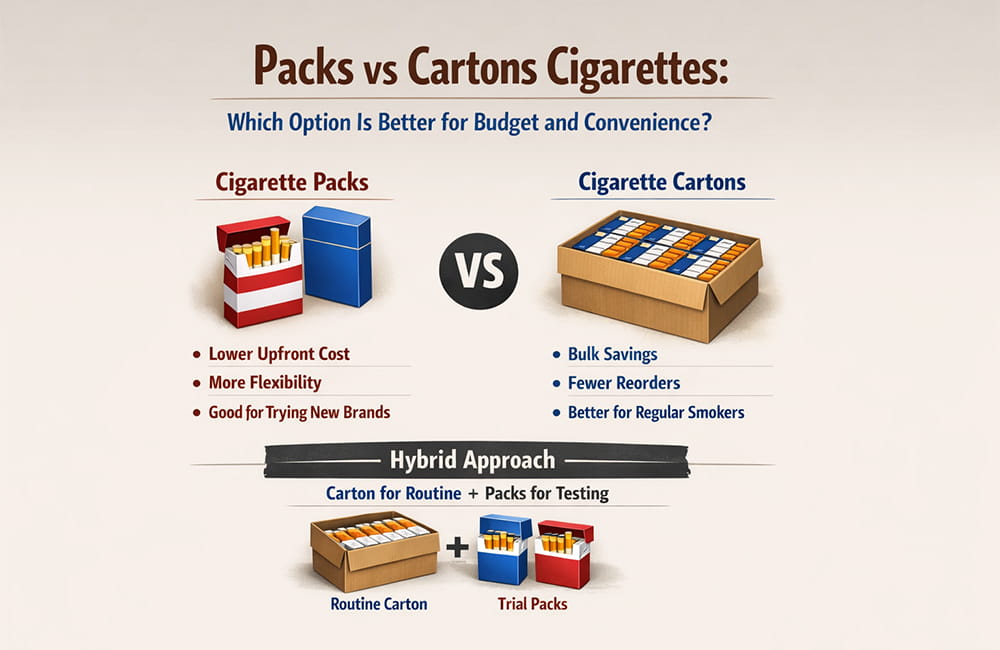
Packs vs Cartons Cigarettes: Which Option Is Better for Budget and Convenience?
Introduction
If you regularly buy cigarettes, one of the most practical decisions you make is not just what brand to buy, but how to buy it: by pack or by carton.
That’s where the keyword topic Packs vs Cartons Cigarettes becomes important. This is not only a pricing question. It also affects your buying routine, how often you reorder, how much you spend at one time, and how convenient the process feels month after month.
Many adult buyers focus only on the immediate checkout total. A pack looks cheaper at the moment, so it feels like the better deal. But if you buy frequently, that small purchase pattern can create more repeat orders, more friction, and less predictable spending. On the other hand, cartons can be more convenient for repeat buyers, but they are not always the right choice if you are still testing brands or managing a tight weekly budget.
This guide breaks it down clearly and practically.
You’ll learn:
- The real difference between packs and cartons
- Which option usually works better for different buyer types
- How to compare cost the right way
- How to reduce reorder friction
- A smart hybrid strategy many buyers use
- Where this fits into a smooth buying workflow on 1Smokes
If your goal is to make smarter buying decisions (not just cheaper-looking ones), this guide will help.
Quick Answer: Packs vs Cartons Cigarettes
Here’s the short version:
- Choose packs if you want flexibility, lower upfront cost, or you are still testing a brand/variant.
- Choose cartons if you buy regularly and want a more predictable, repeat-friendly routine.
- Choose a hybrid approach if you already have one main product but still like trying other options.
The best choice is not “which one is cheaper today.”
The best choice is which one fits your actual buying behavior.
What Does “Packs vs Cartons Cigarettes” Really Mean?
Before comparing, let’s clarify the format decision itself.
Packs
A pack is the smaller retail unit. It’s what most buyers use when they want:
- a lower upfront purchase amount
- more flexibility
- a way to test a brand before committing
Packs are common for buyers who:
- are trying a new brand
- buy in smaller intervals
- prefer more control over each order
Cartons
A carton is a larger unit made up of multiple packs. It’s typically used by buyers who:
- already know what they want
- buy regularly
- prefer fewer reorders
- want a smoother long-term routine
Cartons are less about “bulk for the sake of bulk” and more about efficiency for repeat buyers.
Important note
Exact quantity formats can vary depending on product listing and seller format, so always check the listing details before checkout. The key point in this guide is not the exact count — it’s the buying strategy behind each format.
Why This Decision Matters More Than Most Buyers Think
A lot of people assume this is a small decision.
It isn’t.
The packs vs cartons choice affects:
- How often you reorder
- How much time you spend browsing/checking out
- How predictable your spending becomes
- How likely you are to run out unexpectedly
- How easy it is to repeat your order next time
That means this is not just a “quantity” decision. It is a workflow decision.
If your buying process feels messy, last-minute, or repetitive, there’s a good chance the issue is not the brand — it’s the format.
Packs vs Cartons Cigarettes: The 7 Practical Comparison Factors
To decide correctly, compare packs and cartons using a real-world framework. These seven factors matter the most.
1) Upfront Cost vs Long-Term Buying Value
This is where most people make the wrong comparison.
The common mistake
They compare only:
- “How much is this order today?”
But the better comparison is:
- “What does this buying pattern cost me over time?”
- “How often will I need to reorder?”
Packs: lower upfront spend
Packs usually win on upfront affordability because the immediate payment is smaller. That makes them attractive when:
- you are managing a weekly budget
- you don’t want a larger one-time expense
- you are trying a product for the first time
This is a valid reason to choose packs.
Cartons: stronger long-term buying efficiency
Cartons often make more sense for regular buyers because they reduce the number of times you need to purchase. Even if a carton requires a higher one-time spend, it can improve your routine by making it:
- more predictable
- less repetitive
- easier to manage
This is especially helpful if you buy the same product repeatedly and already know your preference.
Better decision rule
Ask yourself:
- Am I trying to minimize today’s checkout only?
- Or am I trying to make my overall buying routine easier and more stable?
If it’s the second one, cartons often become the better option for repeat buyers.
2) Flexibility vs Commitment
This is one of the biggest differences in the Packs vs Cartons Cigarettes decision.
Packs = flexibility
Packs are ideal when you want flexibility. They let you:
- try different brands
- test different variants
- avoid committing too much to one product
- change your order more often
This is useful if you are:
- new to a category
- switching brands
- comparing variants
- not fully sure about your exact preference yet
Cartons = commitment (in a good way)
Cartons work best when your buying behavior is already stable.
They support:
- repeat buying
- fewer decisions
- less chance of accidental product switching
- a stronger monthly routine
Cartons are not ideal for “testing mode.” They are ideal for “I already know what I buy” mode.
Smart rule
- Testing mode → packs
- Routine mode → cartons
That simple shift prevents most buying mistakes.
3) Budget Style: Weekly vs Monthly Buyers
This is not talked about enough, but it matters.
Two buyers can have the same total spending over time and still prefer different formats — because their budget style is different. Their question is How Much the Carton of Cigarettes in Canada?
Pack-based budget style
Packs are often better if you budget in smaller cycles, such as weekly.
Why it works:
- lower spend per checkout
- easier to fit into smaller budget windows
- less money tied up in one order
Potential downside:
- more frequent purchases can make it harder to track the true monthly total
- repeated “small” orders can feel manageable but still add up quickly
Carton-based budget style
Cartons tend to work better if you budget monthly or prefer a planned buying cycle.
Why it works:
- one larger purchase covers a longer period
- easier to estimate reorder timing
- less transaction repetition
Potential downside:
- the one-time cost is higher
- not ideal if cash flow varies a lot week to week
Budget question to ask yourself
Which statement sounds more like you?
- “I prefer smaller purchases and flexibility” → packs usually fit better
- “I prefer planning and fewer purchases” → cartons usually fit better
4) Convenience and Reorder Friction
This is one of the biggest reasons experienced buyers move from packs to cartons.
What is reorder friction?
Reorder friction is everything that makes repeat buying annoying:
- searching again
- comparing again
- checking out again
- verifying product selection again
- dealing with stock changes or confusion again
Even if each step only takes a few minutes, it adds up over time.
Packs create more reorder events
If you buy by packs only, you will usually reorder more often.
That may be fine if:
- you like frequent control
- your preference changes often
- you don’t mind browsing repeatedly
But for many repeat buyers, frequent small orders eventually become a hassle.
Cartons reduce reorder friction
Cartons are often the better choice for convenience-first buyers because they:
- reduce order frequency
- reduce repeated checkout steps
- make your purchase cycle more predictable
This is why cartons are often a “routine upgrade,” not just a larger quantity.
Quick check
If you often say:
- “I need to reorder again already”
- “I forgot to order sooner”
- “I keep repeating the same order”
…then cartons may solve the real issue.
5) Product Testing and Brand Confidence
A carton only makes sense if you are confident in the product.
That’s why many buyers use a two-stage approach.
Stage 1: Test with packs
Use packs when:
- trying a new brand
- trying a different variant
- comparing options
- checking whether the product fits your preference
This reduces risk.
Stage 2: Move to cartons
Once you confirm the product is a fit and your preference is stable, cartons usually become the better long-term option.
This gives you:
- more convenience
- less reordering
- a cleaner buying routine
Common mistake to avoid
Buying a carton too early just because you want to “save time.”
If you are not sure about the exact product yet, buying a carton can create a frustrating experience. Test first, then commit.
6) Storage and Home Organization
Storage may sound minor, but it affects how practical your order feels after checkout.
Packs: easy, casual storage
Packs are simple to manage because they take up less space and usually don’t require any system.
They are good if:
- you have limited space
- you buy smaller amounts
- you prefer casual storage without planning
Cartons: simple storage system helps
Cartons are still easy to manage, but they work best when you have a consistent place for them.
Basic best practices:
- store in a clean, dry area
- avoid heat and humidity
- keep product variants separated if you buy more than one
- use older/opened items first for better organization
You don’t need anything elaborate. A basic storage routine is enough.
Practical takeaway
If your home setup is disorganized or space is tight, packs may feel easier.
If you have a dedicated spot and like planning ahead, cartons are usually no problem.
7) Buying Behavior and Lifestyle Fit
The right answer depends on the type of buyer you are.
Here’s a practical breakdown.
Buyer Type 1: The Brand Explorer
You compare products often, test variants, and may switch preferences.
Best fit: Packs
Why:
- less commitment
- lower risk
- easier testing
Buyer Type 2: The Weekly Budget Buyer
You prefer smaller purchases that fit a weekly budget.
Best fit: Usually packs
Why:
- lower upfront amount
- more flexibility
- easier short-term budgeting
Buyer Type 3: The Routine Repeat Buyer
You know your preferred product and mostly reorder the same item.
Best fit: Usually cartons
Why:
- fewer reorders
- more predictable routine
- less time spent browsing
Buyer Type 4: The Convenience-First Buyer
You want the lowest-friction process and don’t want to reorder often.
Best fit: Cartons
Why:
- fewer checkout sessions
- less decision fatigue
- better long-term convenience
Buyer Type 5: The Mixed Shopper
You buy a main product consistently but also try other categories or variants sometimes.
Best fit: Hybrid (carton + packs)
Why:
- carton for your regular go-to
- packs for flexibility/testing
- best mix of convenience and variety
Packs vs Cartons Cigarettes: Which Option Usually Wins?
There is no single winner for everyone.
But here’s a realistic summary:
Packs usually win when:
- you are still testing
- your budget is tight week to week
- you want flexibility
- your buying habits are inconsistent
Cartons usually win when:
- you already know your preferred product
- you buy regularly
- you want fewer reorders
- convenience matters more than short-term flexibility
Hybrid wins for many adult buyers
A lot of regular buyers end up using a hybrid strategy:
- carton for the product they always buy
- packs for testing or occasional alternatives
That approach works well because it balances routine and flexibility.
A Practical Cost Comparison Method (Without Overcomplicating It)
A lot of buyers try to compare price but do it in a way that doesn’t reflect real life.
Here’s a better approach.
Don’t compare just the cart total
Instead, compare these three things:
- How long the order lasts
- How often you need to reorder
- How much friction each reorder creates
Example comparison logic
Let’s say a buyer purchases smaller amounts frequently. Even if each order feels cheap, the total monthly process includes:
- more browsing time
- more checkout repetition
- more chances of delay or last-minute ordering
Now compare that with a repeat buyer who orders cartons:
- fewer checkouts
- easier reorder timing
- more stable buying pattern
That’s why “cheaper today” does not always mean “better value for the way you buy.”
Best practical rule
Compare by buying cycle, not by a single checkout.
Ask:
- “Which format makes my next 30 days easier?”
That question usually gives you the right answer.
How to Choose in 60 Seconds Before Checkout
If you want a fast decision system, use this checklist.
Choose Packs if:
- you are trying a new brand/variant
- you want more flexibility
- you are comparing options
- you need a smaller checkout total
- your budget changes week to week
Choose Cartons if:
- you already know what you prefer
- you reorder regularly
- you want fewer purchases
- you want a predictable routine
- you value convenience
Choose Hybrid if:
- you have one main product and occasional alternates
- you want consistency plus flexibility
- you are transitioning from testing to routine buying
This simple checklist is enough for most buyers.
Common Mistakes People Make in Packs vs Cartons Cigarettes Decisions
Avoiding a few common mistakes can improve your buying experience immediately.
Mistake 1: Buying based on habit only
A lot of buyers keep choosing packs because “that’s what I always do.”
But if your buying pattern has become routine, cartons may now be the better fit.
Mistake 2: Buying a carton before confirming preference
If you are not fully sure about the product, start with packs first.
Mistake 3: Looking only at upfront cost
The smaller checkout total can be misleading if it creates constant reordering.
Mistake 4: Ignoring convenience value
Time and friction matter too. If you repeat the same order often, cartons may save effort even if the immediate total is higher.
Mistake 5: No reorder system
Even a basic reorder habit helps:
- reorder on a schedule
- reorder at a threshold
- use the same product/category page for consistency
That one change alone makes online buying smoother.
Building a Smarter Buying Workflow for Online Orders
If you buy online regularly, your experience improves a lot when you treat buying as a workflow instead of a one-time purchase.
Here’s a practical system.
Step 1: Identify your buying pattern
Ask:
- How often do I reorder?
- Do I usually buy the same product?
- Do I run out before I reorder?
Your answers tell you whether packs or cartons fit better.
Step 2: Split your buying into two lanes
Create:
- Testing lane (packs)
- Routine lane (cartons)
This keeps your buying organized and prevents overcommitting.
Step 3: Use one repeat path
Use the same page(s) every time you reorder. This reduces errors and saves time.
Recommended internal pages:
Step 4: Set a reorder trigger
Examples:
- reorder when you reach your last few packs
- reorder on a set day each month
- reorder when your stock reaches a personal threshold
This is especially useful for carton-based routines.
Step 5: Review every few orders
Your best format can change.
- Start with packs
- Move to cartons once preference is stable
- Keep a hybrid setup if you like variety
The best system is the one that stays easy.
Related Product Strategy on 1Smokes (Practical Use Cases)
Here are a few realistic ways buyers can use the packs/cartons strategy on 1Smokes.
Strategy A: First-Time Category Buyer
If you’re new to a category or trying a new brand:
- Start with packs to test preference
- Use the Shop page to compare listings
- Reorder in cartons later only after confirming your preferred option
This avoids overbuying too early.
Strategy B: Routine Repeat Buyer
If you already know what you want:
- Buy your main product in a carton
- Use the same category page for reorders
- Add occasional packs only when testing alternatives
This is the best low-friction setup for many regular buyers.
Strategy C: Mixed Order Buyer
Some adult buyers prefer combining a stable routine item with occasional extras.
A practical structure is:
- Carton for your main repeat product
- Packs for trial options or occasional changes
- One consistent reorder cycle through the Shop page
This gives you both predictability and flexibility.
Is it better to buy packs or cartons of cigarettes?
It depends on your buying pattern. Packs are better for flexibility and testing, while cartons are usually better for repeat buyers who want convenience and fewer reorders.
Are cartons always cheaper than packs?
Not always in the way people think. The better comparison is not just unit price — it’s how the format affects your full buying routine, including reorder frequency and convenience.
Should I buy cartons if I’m trying a new brand?
Usually no. It’s smarter to start with packs first, then move to cartons after you confirm the product matches your preference.
Are packs better for small budgets?
They can be, especially if you budget weekly and want a smaller upfront spend. But if you buy often, it’s still worth looking at your overall monthly pattern.
What is the best setup for regular buyers?
For many regular buyers, cartons are the best format for their main product. A hybrid setup (carton for routine + packs for testing) is often the most practical.
Related Articles
Tobacco Regulations in Canada: What Consumers and Online Buyers Need to Know
Introduction Tobacco regulations in Canada are among the strictest in the world, designed to balance public health goals with legal

The Health Effects of Smoking in Canada: Comprehensive 2026 Guide
Smoking is the leading cause of preventable death in Canada. It causes over two dozen diseases, including lung cancer, heart disease, and COPD. Tobacco use contributes to approximately 48,000 deaths annually, impacting nearly every organ system in the human body.

Buying Cheap Cigarettes Online in Ontario: How to Compare Stores, Discounts, and Legal Restrictions
Introduction Buying Cheap Cigarettes Online in Ontario has become more common as shopping online has changed almost everything—except the fact