Skip to navigation
Skip to main content

Blog
Tobacco Regulations in Canada: Federal and Provincial Rules in 2026
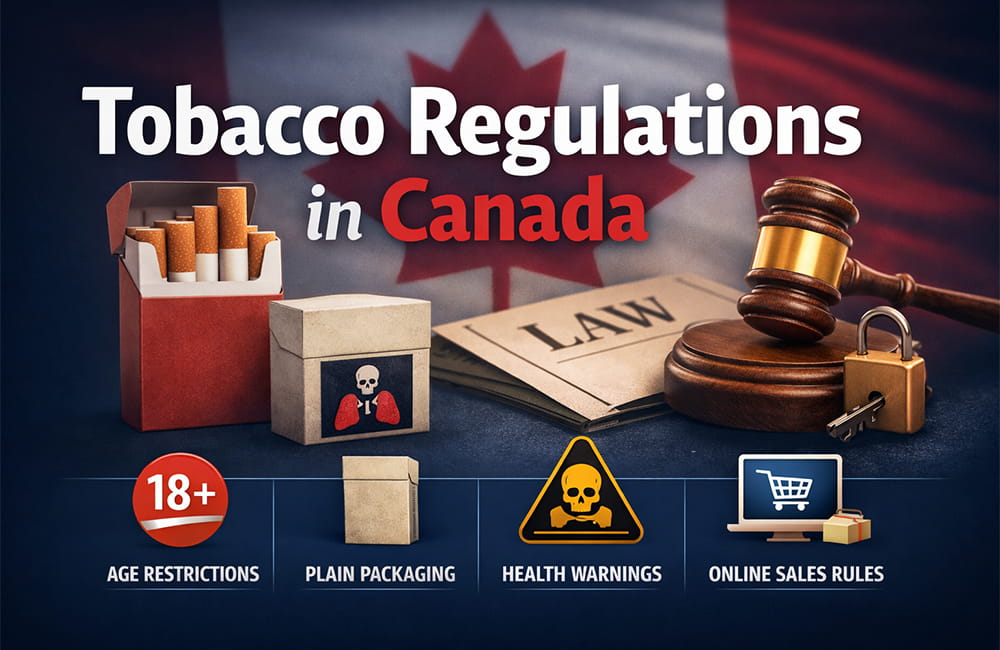
Tobacco regulations in Canada come from several levels of government. Federal law addresses tobacco products, packaging, promotion and youth access. Provinces and territories add rules for sales, identification, retail operations and where tobacco may be used. Municipal bylaws can add further restrictions. A rule that applies in one province won’t necessarily apply to a sale in another.
This guide explains the main legal distinctions as of November 3, 2026. You’ll also find government sources to check when a retailer’s statement or an older guide leaves you unsure. It provides general information, not legal advice for a particular transaction or business.
What Do Tobacco Regulations in Canada Cover?
Canadian tobacco laws cover more than the minimum age for purchasing cigarettes. They also regulate how tobacco is packaged, promoted, taxed and sold. Which rules matter? That depends on the product, the location and the transaction. A general guide can’t settle every retailer’s compliance obligations.
Who regulates what?
| Authority | Main area addressed | Where to verify |
|---|---|---|
| Health Canada and federal legislation | Tobacco product rules, packaging, warnings, promotion and federal youth protections | Health Canada’s tobacco regulations |
| Canada Revenue Agency (CRA) | Federal tobacco excise duties and excise stamps | CRA excise stamp guidance |
| Provincial and territorial governments | Additional minimum ages, retail rules, identification requirements, taxes and restrictions on sales | Relevant provincial or territorial statutes and regulator pages |
| Municipal governments | Local smoking restrictions and other bylaws within their authority | The municipality’s official bylaws |
For example, the federal minimum age won’t override a higher provincial minimum. And the federal statute alone won’t tell you whether a particular remote-sale arrangement is permitted.
Are tobacco and vaping laws identical?
No. The Tobacco and Vaping Products Act addresses both tobacco and vaping products, but different sections and regulations can apply. Some provincial provisions cover both; others draw separate lines. You shouldn’t assume the requirements for a cigarette package also apply to a nicotine pouch or vaping liquid.
What Does the Tobacco and Vaping Products Act Require?
The federal Tobacco and Vaping Products Act (TVPA) establishes nationwide restrictions intended to protect public health, particularly young people. Its framework includes limits on furnishing tobacco to young persons and rules on tobacco promotion, access and product-related information. Provinces and territories can impose additional restrictions.
Youth access and tobacco sales
At the federal level, a “young person” under the TVPA is someone under 18. This doesn’t mean every province permits sales to everyone aged 18. Some provinces set their minimum tobacco sales age at 19, and retailers must consider the rules that apply in their jurisdiction.
A pop-up that asks visitors to confirm their age doesn’t prove that the retailer has completed legally required checks. The actual legal standard depends on the applicable law and selling arrangement.
Advertising and misleading terms
Tobacco promotion is restricted under federal law. For example, Health Canada’s rules prohibit specified uses of the terms “light” and “mild” and their variations on certain tobacco products, packaging, advertising, promotions and retail displays. These words shouldn’t be read as evidence of reduced health risk.
Provincial rules also govern what retailers can display or promote. A claim about permitted advertising needs two checks: which tobacco product is involved, and where is it being marketed?
What Are Canada’s Tobacco Packaging Rules in 2026?
Canada’s Tobacco Products Appearance, Packaging and Labelling Regulations (TPAPLR) set federal requirements for the appearance of tobacco products and for health warnings, toxicity information and other health-related messages. Packaging compliance is a distinct issue from tax compliance or proof of a product’s manufacturer.
Plain packaging and health information
The regulations require standardized appearance and health-related information on tobacco products and packages. Requirements vary by product type. Health Canada also describes warnings printed directly on certain individual cigarettes, little cigars and tubes. A warning on the box is only part of the picture.
What changed by October 31, 2026?
Health Canada lists October 31, 2026 as the date by which retailers were to sell cigarette packages carrying a health information message on an extended upper slide-flap. The corresponding manufacturer and distributor milestone was July 31, 2026. These dates relate to this specific packaging requirement, not every part of tobacco regulation.
Older guides may still describe that deadline as upcoming. Check Health Canada’s schedule for the relevant product and compliance date.
How Do Tobacco Age Restrictions Differ Across Canada?
The legal age for tobacco sales isn’t uniform across every Canadian jurisdiction. The federal youth-protection threshold is under 18, while provinces can set higher minimum ages and different identification procedures. So a bare answer of “18” or “19” misses the jurisdictional question.
Selected officially verified examples
| Province | Minimum tobacco sales age | Additional detail |
|---|---|---|
| Alberta | 18 | Alberta specifies government-issued photo identification requirements. |
| British Columbia | 19 | Provincial regulation specifies 19 as the minimum age. |
| Ontario | 19 | The retailer must request identification when a customer appears younger than 25. |
| Saskatchewan | 19 | Provincial guidance restricts tobacco sales to those 19 or older. |
These are four examples, not a complete 13-jurisdiction list. For another province or territory, consult its current retailer guidance. The minimum age and the duty to request identification aren’t always the same rule.
Why identification rules matter
A customer’s age and a retailer’s duty to request identification are related, but separate questions. Ontario provides a useful example: the legal minimum is 19, yet the law requires an ID check when someone appears under 25. It’s therefore misleading to describe “minimum age” as the entire verification rule.
Is Buying Tobacco Online Legal Everywhere in Canada?
No single nationwide yes-or-no answer is reliable. Federal tobacco requirements coexist with provincial and territorial rules governing retail sales. A site’s checkout page, delivery offer or statement of compliance doesn’t override restrictions in the jurisdiction where a sale is made. The seller’s location, delivery destination and applicable laws all need consideration.
Québec shows why province-specific checks are essential
The Québec government’s published Tobacco Control Act guidance identifies an offence for selling tobacco at retail anywhere other than a tobacco retail outlet with the purchaser physically present. This is a significant restriction that a generic claim about legal nationwide online cigarette sales would overlook.
Québec’s approach can’t be projected onto the other provinces. Each destination needs its own legal check.
What about delivery and age gates?
Delivery and remote-sale arrangements can raise separate questions about seller authorization, age and identity checks, and jurisdiction-specific restrictions. Don’t treat a website’s “18+” or “19+” badge as a legal opinion. Nor does the presence of an excise stamp resolve the legal questions about how a product may be sold or delivered.
No checkout sequence, however polished, substitutes for the applicable statute. Check the provincial regulator’s guidance for a specific arrangement.
How Are Tobacco Products Taxed and Stamped?
Canadian tobacco prices can reflect multiple taxes, including federal excise duty and applicable provincial taxes. These obligations aren’t interchangeable, and a displayed retail price doesn’t establish that every legal requirement for a transaction has been satisfied. The CRA administers federal tobacco excise provisions under the Excise Act, 2001.
Federal excise duty in 2026
The CRA’s rate notice effective April 1, 2026 lists a federal excise duty rate of $0.97299 per five cigarettes, or fraction of five, contained in a package. That figure is a federal excise-duty rate, not the total tax on a retail pack or a quoted consumer price. The applicable duties on other tobacco categories differ.
The effective date matters. An older rate, or a US tax reference, won’t answer a Canadian excise-duty question in November 2026.
What does a tobacco excise stamp prove?
The CRA explains that excise stamps provide evidence that federal excise duty has been paid, where the stamp requirement applies. Stamps can carry “Duty Paid Canada” wording and identifying features. Their principal purpose is tax administration and compliance; they’re not a universal guarantee that a manufacturer made a particular product.
Special tax treatment can apply to exported, duty-free or other products. In an ordinary taxable retail setting, a missing stamp raises a serious concern, but the legal context still matters.
For more detail on how packaging, origin and verification differ, see our article on product authenticity and customer trust.
How Can Readers Verify Which Canadian Tobacco Laws Apply?
Start with the question you’re trying to answer, then find the regulator responsible. For a concrete legal issue, the governing statute and official guidance matter more than a retailer’s summary. They often contain exceptions that a short article won’t cover.
A practical source-checking framework
- Define the subject. Are you checking minimum age, packaging, advertising, tax, delivery or retailer authorization? These questions don’t all belong to the same regulator.
- Identify the place. Record the province or territory and any relevant municipality. Don’t presume that Ontario’s law applies in Québec.
- Check federal requirements. Consult Health Canada for tobacco product rules or the CRA for excise duties and stamps.
- Check the local law. Open the applicable provincial or territorial act, regulations and retailer guidance. Read exceptions and effective dates, not only a headline summary.
- Check how recent the information is. A page can describe a genuine requirement and still be outdated if the regulation or compliance deadline has changed.
Consider a cigarette package: Health Canada covers appearance and warnings, while the CRA deals with federal excise stamps. If the question concerns whether a remote retail sale is allowed in Québec, Québec’s tobacco law is the essential additional source. One source won’t answer all three questions.
Where related topics belong
Some issues warrant a closer look. Our menthol cigarettes in Canada explainer discusses the flavour-related question in more detail. The broader 1Smokes product authenticity guide examines what packaging and verification claims can, and can’t, establish. Neither article replaces the applicable law.
Frequently Asked Questions
What is the legal age to buy cigarettes in Canada?
The federal TVPA protects persons under 18, but provinces can impose higher tobacco sales ages. For example, Alberta’s minimum is 18, while Ontario, British Columbia and Saskatchewan use 19. Check the law in the relevant province or territory rather than assuming one national retail age.
Are plain cigarette packages mandatory in Canada?
Federal tobacco packaging rules impose standardized appearance and health-message requirements. Requirements vary by product; refer to Health Canada’s current schedule and regulations for the details.
Can you buy tobacco online in every province?
You shouldn’t assume so. Québec identifies an offence involving retail tobacco sales without the purchaser physically present at a tobacco retail outlet. Other jurisdictions need their own legal assessment. A website’s age gate doesn’t prove that its selling arrangement meets every applicable rule.
What does a Canadian tobacco excise stamp mean?
A stamp generally indicates the relevant federal excise duty has been paid on a product subject to stamping requirements. It doesn’t, on its own, authenticate a brand or establish that a remote retail transaction is legally permitted.
Are vaping regulations the same as tobacco regulations?
Not necessarily. Federal and provincial frameworks can cover both categories, but the product definitions, permitted promotions, packaging rules and other restrictions aren’t identical. Always check which product class the legal requirement names.
Key Takeaways
Federal tobacco laws address products, promotion and youth protections. Provinces and territories add retail, age and sales requirements that may be more restrictive. The rules for packaging, online sales and excise stamps answer different questions, so none should be used as a shortcut for proving overall compliance.
If you’re using this article to check a specific legal issue, start with the official source for that issue and verify its jurisdiction and effective date. The government links below are the basis for the dated claims in this guide.
Official Sources
Health Canada, Tobacco product regulations.
Health Canada, Protection of young persons: Key prohibitions under the TVPA; Tobacco and Vaping Products Act.
Health Canada, Promotion of Tobacco Products and Accessories Regulations: Prohibited Terms.
Health Canada, Tobacco Products Appearance, Packaging and Labelling Regulations.
Government of Alberta, Reducing smoking and vaping: Rules and enforcement.
Government of British Columbia, Tobacco and Vapour Products Control Regulation.
Government of Ontario, Smoke-Free Ontario Act, 2017.
Government of Saskatchewan, Tobacco and Vapour Products.
Gouvernement du Québec, Tobacco Control Act.
Canada Revenue Agency, Adjusted rates of excise duty on tobacco products effective April 1, 2026 (EDN105).
Canada Revenue Agency, Excise stamps: Information for consumers.
Related Articles
Nicotine Pouch Strengths Explained: 6mg to 15mg on One Shelf
What the mg number on a nicotine pouch lid actually measures, how 6mg, 9mg, 12mg and 15mg cans compare, and how to swap strengths when your usual can is out of stock.

Where to Buy Cartons of Cigarettes: What to Verify First
If you’re searching for where to buy cartons of cigarettes in Canada, you’ll usually be comparing online cigarette retailers with

How Long Do Disposable Vapes Last? Estimate Your Own Lifespan
Adult-use note: This guide is written for adults of legal age who already use vaping products. It explains device lifespan