Prices
Cigarette Prices Canada (2026): Pack & Carton Price Guide for Adult Buyers
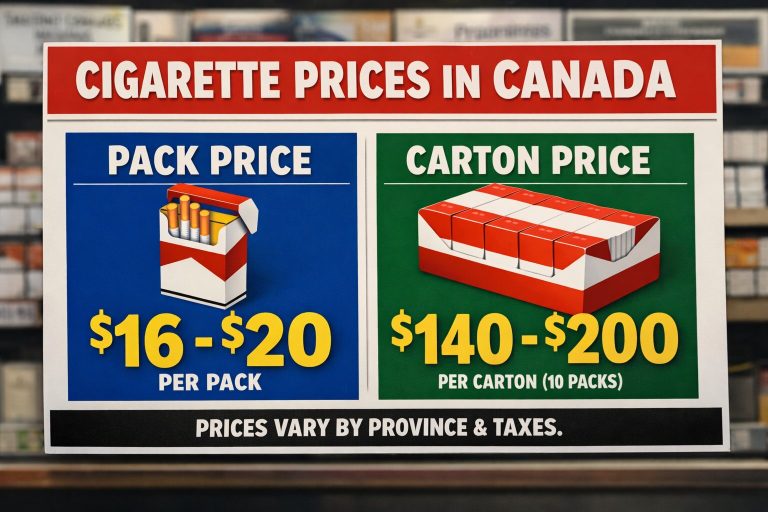
Cigarette prices in Canada feel expensive for one core reason: taxes are intentionally high and layered, and those layers differ by province. On top of that, real-world pricing varies by brand positioning, format (regular vs king size), strength style (light vs full flavor vs menthol), and where/how you buy (retail vs online, packs vs cartons).
This pillar page is designed for adult smokers of legal age in Canada who want a clear, practical way to understand and compare pricing—without vague estimates, without “too good to be true” hype, and without turning into a tax-law lecture.
You’ll learn:
why cigarette prices vary so much across Canada
how to compare packs vs cartons correctly (cost-per-cigarette)
what “cheap cigarettes” realistically means in a high-tax country
how different product choices impact price
what to verify to avoid questionable or illegal products
how to navigate value options efficiently using 1Smokes category paths
Note: This is an informational guide. Prices change frequently due to tax updates, supply, and retailer pricing. Use the comparison method here to make accurate decisions based on the prices you see at the moment you’re shopping.
Overview
Canada-wide price differences are driven mostly by provincial tobacco taxes, then sales tax structure (GST/HST/PST), plus federal excise and retailer markup.
Cartons usually reduce cost-per-cigarette versus buying single packs—when you already know what you want.
A “cheap” offer that is far below typical Canadian norms often comes with legitimacy risk—always verify the product is compliant and properly stamped where required.
The simplest way to compare value is cost per cigarette (pack ÷ 20 vs carton ÷ 200).
What People Mean by “Cigarette Prices in Canada”
When someone searches cigarette prices Canada, they usually want one of these answers:
What does a pack cost where I live?
Pack pricing in Canada depends mostly on provincial tobacco tax + GST/HST/PST, then retailer markup. For a realistic local baseline, compare 3 similar listings (same pack size + same type: light/full/menthol) and use the middle price.
Why does my province cost more than another?
Because provinces apply different tobacco tax rates and different sales tax structures (GST only vs GST+PST vs HST). Same product, different tax stack = different final price.
Is it cheaper to buy cartons?
Usually yes on cost-per-cigarette, if your choice is stable.
Pack value = pack price ÷ 20
Carton value = carton price ÷ 200
Cartons can also reduce reorders and unlock bulk tiers, but cost more upfront.
How do taxes affect what I pay?
Canadian cigarette prices include layered taxes: federal excise, provincial tobacco tax, and GST/HST/PST. When tax rates increase, pack and carton pricing usually increases too.
How do I find legitimate value options (not sketchy deals)?
Use compare + verify: normalize value (cost-per-cigarette), avoid prices that are far below normal, and choose sellers with clear product details, policies, and consistent compliance signals. For routine savings, use cartons/bulk; for testing, use packs.
The Pricing Formula: What You’re Paying For
Canadian cigarette pricing is best understood as a stacked equation. If you don’t understand the stack, it’s easy to compare the wrong things.
The “stack” in plain terms
Final price you pay generally includes:
Base product cost (tobacco product cost + manufacturing/wholesale)
Federal excise duty (applies across Canada)
Provincial tobacco tax (varies by province/territory)
Sales taxes (GST/HST/PST depending on your province)
Retail/online markup + operating cost (logistics, payment processing, support, inventory risk)
Why this matters
If a province increases tobacco taxes, pack and carton prices typically rise—even if the brand and retailer stay exactly the same.
Why Prices Differ by Province
If you’ve ever visited another province and noticed different cigarette pricing, you weren’t imagining it. Provincial tax policy is the biggest reason.
Key drivers of province-to-province differences
Provincial tobacco tax levels and how they’re structured
Sales tax structure (GST only vs GST+PST vs HST)
Enforcement and market dynamics that influence retail pricing
Distribution and retail overhead (especially in remote or low-density areas)
What doesn’t usually explain large differences
The product itself (same product can vary in price mainly due to the province and retailer)
“Online is always cheaper” (sometimes it’s competitive, but it’s not a guarantee)
Pack vs Carton: Compare the Right Way (Cost per Cigarette)
Price shoppers often make the same mistake: they compare carton price vs pack price without normalizing the quantity.
The correct comparison method
Pack: usually 20 cigarettes
Carton: usually 10 packs = 200 cigarettes
Cost per cigarette = total price ÷ number of cigarettes
Quick example (template)
If a pack is $X, cost per cigarette = X ÷ 20
If a carton is $Y, cost per cigarette = Y ÷ 200
Then compare those two results.
This works for every brand and every province because it’s quantity-based.
Comparison Table 1: Pack vs Carton Pricing (Value Patterns)
| Comparison Factor | Buying Packs (20s) | Buying Cartons (10 packs / 200s) | Best Choice If You… |
|---|---|---|---|
| Upfront cost | Lower | Higher | Packs = tight budget today / Cartons = planned spend |
| Cost per cigarette | Usually higher | Usually lower | Want the lowest cost-per-cigarette → carton |
| Best for testing new brands | Yes | Not ideal | Still exploring → packs |
| Reorder convenience | Moderate | High (fewer reorders) | Hate reordering → carton |
| Risk if you dislike it | Lower | Higher | Not sure you’ll like it → packs |
| Bulk discounts | Rare | Common | Want tiered savings → carton |
| Inventory at home | Small | Larger | Prefer less stock at home → packs |
| Best use-case | Variety / trial | Value / routine | Value buyers → carton routine |
What “Cheap Cigarettes in Canada” Realistically Means (2026)
In Canada, “cheap” almost never means “low-tax.” Taxes are a major part of the final price and they don’t disappear in legitimate channels.
So when buyers say “cheap,” they usually mean:
lower cost per cigarette (cartons + bulk)
better value brand positioning
discount tiers (buy more, save more)
consistent reorder availability (so you don’t get forced into pricier alternatives)
The 4 levers that actually reduce spend (without guessing)
Lever 1: Cartons
Cartons are the most common way adult buyers reduce long-run cost-per-cigarette.
Lever 2: Value
Some products are priced for value buyers. The trade-off can be taste profile, strength feel, or tobacco blend preferences.
Lever 3: Bulk discounts / tiered savings
If a store offers bulk tiers, your “best price” may appear only after you cross a quantity threshold.
Lever 4: Fewer experiments, smarter experiments
If you’re constantly testing random options, you may waste money on products you don’t enjoy.
Product Choices That Affect Price: Format, Strength, and Category
Even within the same province and retailer, different product specs can affect pricing.
Format: regular vs king size (and similar variations)
Longer formats or different pack configurations can alter pricing. Don’t assume “same brand = same value.” Always normalize by quantity where possible.
Strength style: light vs full flavor vs menthol
Strength style changes demand patterns and sometimes pricing. More important: it changes your satisfaction per cigarette, which affects consumption and reorders (a hidden cost driver).
Brand positioning: premium vs value
Premium positioning typically costs more. Value lines are built for buyers who prioritize cost-per-cigarette and consistency.
Cartons & bulk categories
Bulk categories often surface the best cost-per-cigarette options faster than browsing packs.
Comparison Table 2: “Cheapest” Options Compared (Trade-offs)
| Option Type | Typical Price Outcome | Main Upside | Main Trade-Off | Good For |
|---|---|---|---|---|
| Cartons & bulk | Best value per cigarette | Lowest cost-per-unit, fewer reorders | Higher upfront spend | Price-first buyers |
| Value-focused brands/lines | Often lower than premium | Cheaper without changing format | Taste/strength may differ | Budget + consistency |
| Packs (single) | Highest per-unit | Low upfront cost, easy to test | Higher long-run spend | Brand explorers |
| Online ordering | Can be competitive (esp. cartons) | Convenience + browsing | Must verify legitimacy & policies | Limited retail access |
| Retail convenience stores | Often higher | Immediate purchase | Convenience markup | Emergency buys |
Province Comparison Table: What Usually Drives Higher vs Lower Prices
(This is intentionally structural—not exact pricing—because prices move with policy and retailer updates.)
| Factor | Tends to Increase Final Price | Why It Matters to Buyers |
|---|---|---|
| Provincial tobacco tax | Higher tax = higher price | Biggest source of province-level variation |
| Sales tax structure | Higher combined tax burden | Adds to total cost; varies by province |
| Retail environment | High overhead, low competition | Convenience markup or fewer value options |
| Distribution/logistics | Remote or limited access | Can raise retail/online operating cost |
| Product category | Premium lines / special formats | Not all products are priced for value |
How to Spot Legit Pricing vs “Too Cheap to Be True”
Canada has a known issue with contraband tobacco. From a buyer perspective, you don’t need to be an investigator—you just need to avoid obvious red flags.
Quick legitimacy checklist (buyer-level)
Packaging should appear consistent and professional (no sloppy print, mismatched elements)
Seller should provide clear policies (shipping, support, returns where applicable)
Pricing should be plausible relative to typical Canadian norms (especially after tax)
The product should be compliant with relevant requirements (including stamp requirements where applicable)
Red flags
Prices that are dramatically below normal Canadian expectations
No clear store identity, support channel, or policies
Vague product details (no quantity clarity, no category clarity)
Pressure tactics (“only today” everywhere, constant urgency)
If something feels off, treat it as a cost risk—not a deal.
How to Shop Cigarette Prices Efficiently on 1Smokes
1Smokes is positioned around:
competitive pricing and bulk discounts
online convenience and delivery (as presented on-site)
broader adult category access (including nicotine pouches & vapes)
The fastest way to price-shop is to start with the most “value structured” categories first.
Internal Links
Compare bulk value: carton cigarette prices in Canada
Go straight to price-first picks: cheapest cigarettes in Canada
Browse budget-friendly options: cheap smokes in Canada
Explore all products quickly: shop cigarettes online
Filter by cigarette types: browse cigarettes
Buying Strategy by Buyer Type (Adult, Price-Conscious)
A) The “lowest cost-per-cigarette” buyer
Best path:
✅ Start with cartons/bulk
✅ Choose 1 default carton for consistency
✅ Use alternates only if stock changes
Most common mistake: buying random packs and then wondering why monthly spend is high.
B) The “brand explorer” buyer
Best path:
✅ Use packs for testing
✅ Once you find a match, convert it into a carton routine
✅ Keep one “safe fallback” product you know you’ll tolerate
C) The “limited retail access” buyer
Best path:
✅Prioritize reliable availability and clear policies
✅ Use online categories to compare quickly
✅ Buy cartons if your routine is stable (reduces reorder stress)
D) The “nicotine alternative” user (pouches/vapes + cigarettes)
Best path:
✅ Decide what role cigarettes play (primary vs occasional)
✅ If occasional, packs may make more sense than cartons
✅ If primary, carton math often wins
Find Better Value on Cigarette Prices in Canada (Adult Only)
If you’re comparing cigarette prices in Canada, the fastest way to get real value is to stop guessing and start comparing like-for-like. Begin with your preferred type (light, full flavor, or menthol), then decide whether you’re buying for today (packs) or for routine savings (cartons). When your choice is stable, cartons usually deliver a lower cost-per-cigarette, fewer reorders, and clearer bulk value.
To explore options quickly, use these shortcuts: start with carton cigarette prices in Canada to see bulk value first, then check cheapest cigarettes in Canada for price-first picks, and browse cheap smokes in Canada when you want budget-friendly variety. If you prefer to compare everything in one place, you can shop cigarettes online and filter by type, strength style, and pack/carton format to match your routine.
Your goal is simple: choose a product you’ll actually stick with, confirm the quantity, compare cost-per-cigarette, and reorder confidently when availability is consistent.
Common Questions About Cigarette Prices in Canada (FAQ)
What is the average price of a pack of cigarettes in Canada?
It depends on province/territory, tax structure, and retailer pricing. The best approach is to compare within your province and use pack vs carton math when evaluating value.
Why are cigarettes so expensive in Canada?
High tobacco taxes (federal + provincial) plus sales taxes and retail markup drive the final price. Canada’s pricing environment is intentionally “tax heavy.”
Are cartons always cheaper than packs?
Not always, but they are usually lower cost-per-cigarette when comparing like-for-like products. If you’re still experimenting, packs can be the smarter choice.
What’s the best way to compare cigarette prices online?
Use:
cost-per-cigarette math (pack ÷ 20, carton ÷ 200)
reorder reliability (availability)
legitimacy checks (clear policies, plausible pricing, compliant product presentation)
Can cigarette prices change suddenly?
Yes—tax updates, supply disruptions, and retailer repricing can change prices over short periods.
How much is a carton of cigarettes in Canada?
Carton pricing varies by province and retailer because of provincial tobacco taxes, sales taxes, and markup. The most accurate way to compare cartons is to calculate cost-per-cigarette (carton price ÷ 200) and compare it to pack value (pack price ÷ 20).
Do “light” cigarettes cost less than full flavor or menthol in Canada?
Not always. Price is driven more by taxes, brand positioning, and retailer pricing than by “light vs full flavor vs menthol.” Treat strength style as a preference choice, then compare value using the same pack/carton quantity.